
How often does Valius result in a prescribed therapeutic?
How often does Valius result in a prescribed therapeutic?
How often we're able to help our patients
Announcements
.png)
Introduction to the “measured vs. reported gap"
Most of the patients we see at Valius have already done some diagnostic work before they get in touch with our team.
Oftentimes, these diagnostics take the form of a standard gene panel assessing a few hundred genes. Sometimes, patients have also gotten a more robust whole exome (DNA) and whole transcriptome (RNA) workup assessing tens of thousands of genes.
In the former case, the typical issue our patients face is that the test didn’t measure enough—that is, it didn't find any actionable mutations or amplifications in the several hundred genes it analyzed. In the latter case, though, the more common problem is that the test, or the vendor performing it, didn’t report enough.
At Valius, we refer to this latter problem as the “measured vs. reported gap”—in other words, the difference between what an advanced diagnostic test was able to measure and what the diagnostic vendor actually reported back to the patient and their physician. This gap is startlingly large today.
Example of the "measured vs. reported gap" from one of our patients
Consider the example of an astrocytoma patient we worked with recently.
Before partnering with Valius, this patient received a whole transcriptome (RNA) workup from a traditional diagnostic vendor (see a screenshot from their report below). Despite having the data to calculate the RNA expression of different genes—highly-relevant statistics for patients hoping to access many classes of therapeutic—the vendor focused its transcriptomic report solely on fusions and rearrangements. In this case, they found none, and their report failed to surface a single treatment option for the patient.
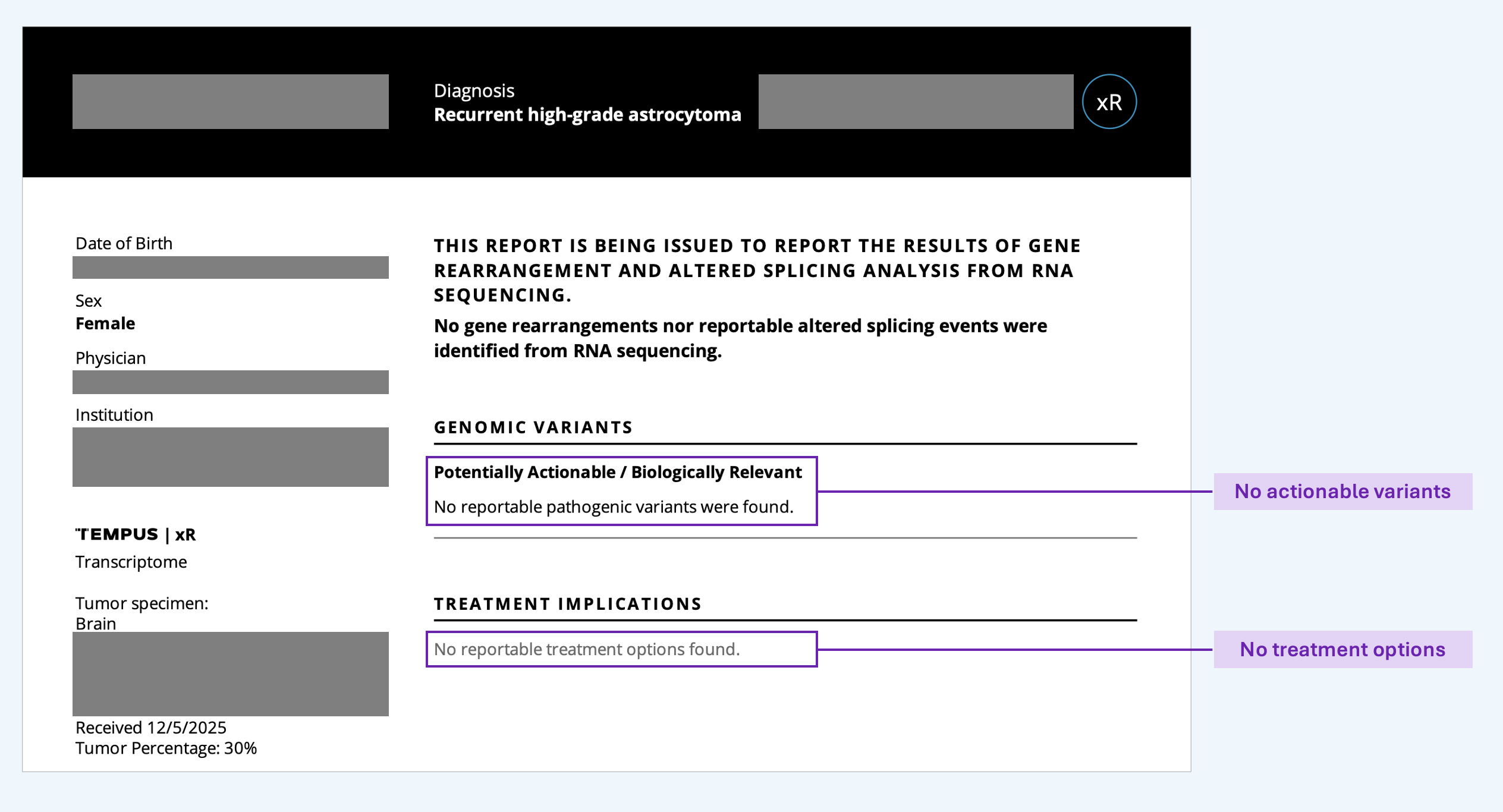
When the patient came to Valius, we began our workup, as we do for all of our patients, with the exact same test: whole transcriptome sequencing.
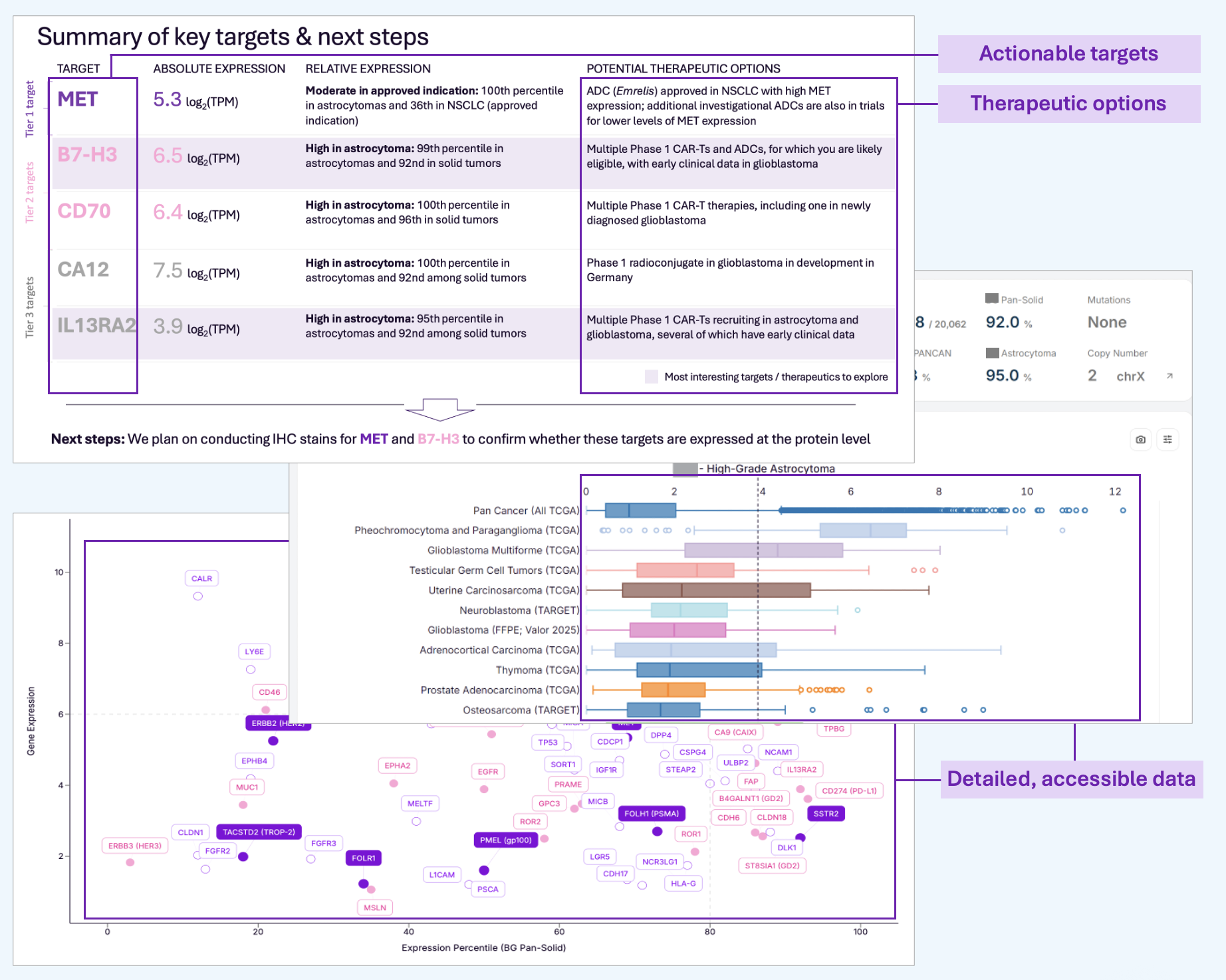
Right away, we found several potentially clinically-relevant findings, including high B7-H3 expression, high IL13RA2 expression, and high MET expression in the patient's tumor cells. Critically, all of these targets have corresponding therapeutics that are either approved in another indication or in development for central nervous system (CNS) tumors like astrocytomas.
We reported all of this data back to the patient, along with accessible graphics and detailed therapeutic summaries, so that they could have a maximally informed discussion with their oncologist about next steps (see screenshots below).
Ultimately, the patient decided to pursue access to one of the therapeutic options we identified.
How we're closing the "measured vs. reported gap"
In contrast to traditional diagnostic vendors, we try to ensure that everything we measure makes its way to the patient and their care team. We’re also constantly investing in newer and better ways to empower patients with their data.
We recently developed our first patient-facing data portal, where patients can download and share all of the analytical reports and raw data generated from our diagnostic tests. In the not-too-distant future, we'll also arm our patients and their physicians with interactive tools to help them visualize and interrogate their data (more on that coming soon).
We’re closing the "measured vs. reported gap" for good.
.png)