
Why we care about RNA
Why we care about RNA
Why we perform RNA sequencing for all of our patients
Perspectives

In July, we wrote about why we perform RNA sequencing, and how single-cell (RNA) transcriptomics helps us refine the list of treatment options we present to patients.
Today, we’re proud to announce that, starting in early 2027, we’ll complement this diagnostic approach with spatial RNA sequencing, using Atera–a first-of-its-kind instrument designed by 10x Genomics.
With this investment, we’ll aim to be the first diagnostics company to bring spatial RNA sequencing into clinical care.
Below, we explain why we’re building our own spatial RNA sequencing capabilities and how it will help patients and their care teams make better treatment decisions.
First, what is spatial RNA sequencing?
Right now, our diagnostic suite employs single-cell RNA sequencing, an approach that allows us to separate the non-malignant (“stromal”) cells in a patient’s sample from the malignant cells. Specifically, it helps us to determine which genes are selectively expressed in the latter group, and thus, which targets a therapy could address.
Unfortunately, performing single-cell RNA sequencing requires dissociating the tissue sample (that is, breaking down the proteins that hold the cells together), meaning that the cells’ spatial configuration is lost in the process.
Spatial RNA sequencing will allow us to perform this fine-grained RNA sequencing while preserving the spatial relationships between cells. In essence, armed with spatial, we’ll be able to create a complete portrait of the transcriptomic behavior of the tissue sample: the RNA expression of each cell with its exact location in space.
What’s more, we’ll use less patient tissue running spatial RNA sequencing than we would have running single-cell.
What does this mean for our patients?
Spatial RNA sequencing data will transform the way we evaluate treatment options for patients.
We believe this because we’ve tested it.
Earlier this year, our team downloaded a publicly available cervical cancer dataset and ran an analysis as a mock case, as though the data came directly from one of our own patients. We asked ourselves how, if at all, the spatial data would impact our therapeutic recommendations.
Using the diagnostic algorithms we’ve developed and integrated to date, we determined that: 1) the patient’s sample showed high expression of TROP-2, a target of an approved antibody-drug conjugate (ADC) therapy in triple-negative breast cancer, which is also being tested in cervical cancer and other indications; and 2) the patient’s TROP-2 expression was much more prominent–over four times higher–in the tumor cells versus the stromal cells.
We were also able to identify several subset populations of the patient’s tumor, which we divided into two major groups: basal- and squamous-like tumor cells (“group A”) and hypoxic tumor cells (“group B”).
That’s a lot of information about this tumor–much more data than patients typically see. But without spatial, it’s not quite a complete map.
For example, without considering this sample’s spatial data, we aren’t able to say whether these different groups of cells are intermingled or separated. Furthermore, we can’t understand the exact location of the high TROP-2 expression in the tumor, and whether an ADC molecule would likely be able to reach the TROP-2 targets.
That’s where spatial sequencing comes in.
With spatial, we were able to map each cell we analyzed onto its spatial coordinates. The picture that appeared showed two types of tumor nests, differentiated by group.
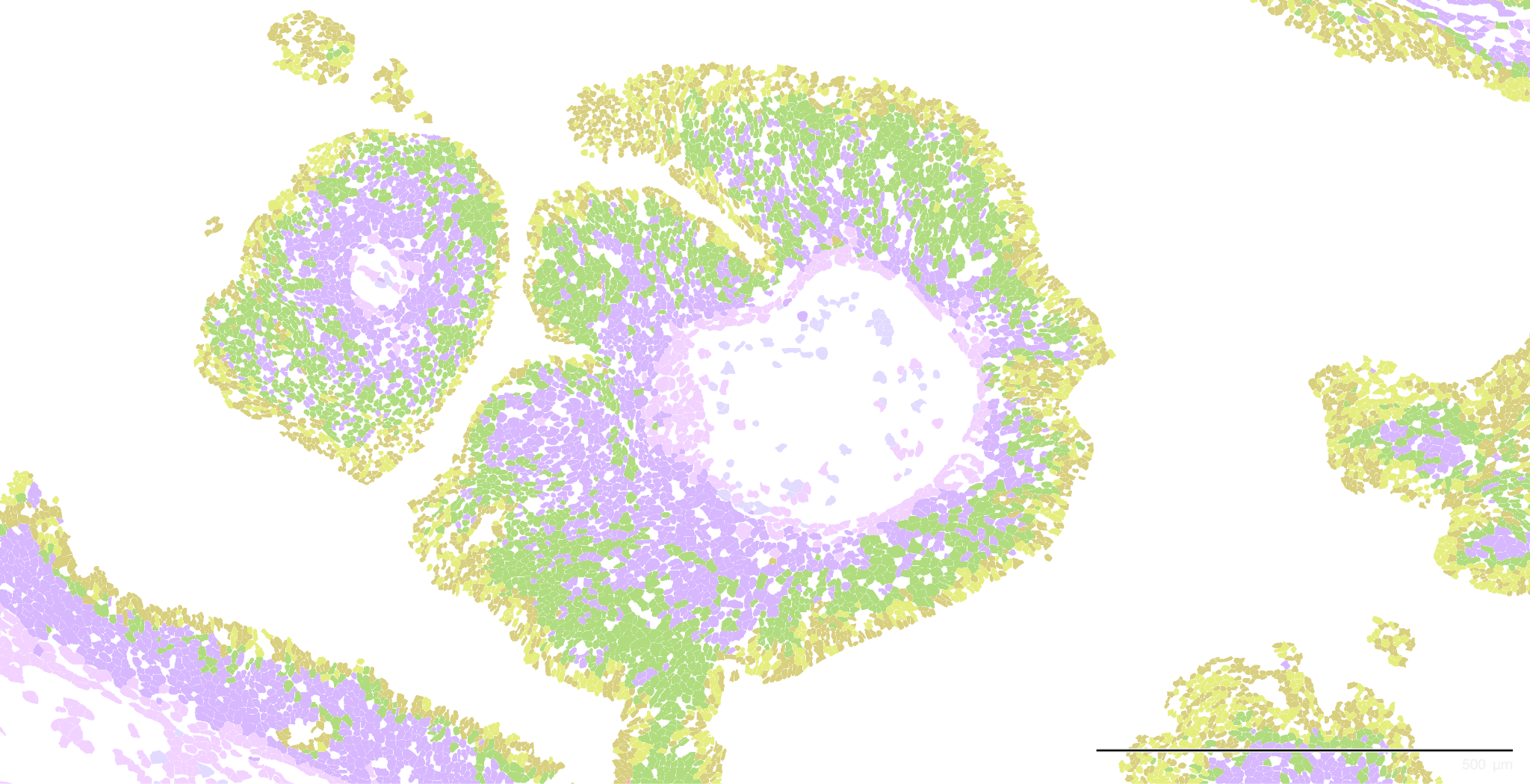

The first type of tumor nest (above left) contains mostly group-A cells; the second (above right) consists mostly of group-B cells.
Here’s why the spatial piece matters: for this patient, both types of tumor nests have higher TROP-2 expression on the inside than at the edges (see below). That’s the ideal spatial distribution for therapeutic efficiency. It suggests that ADCs will be able to penetrate the nest and reach the cells within, rather than being absorbed at the outer rim.
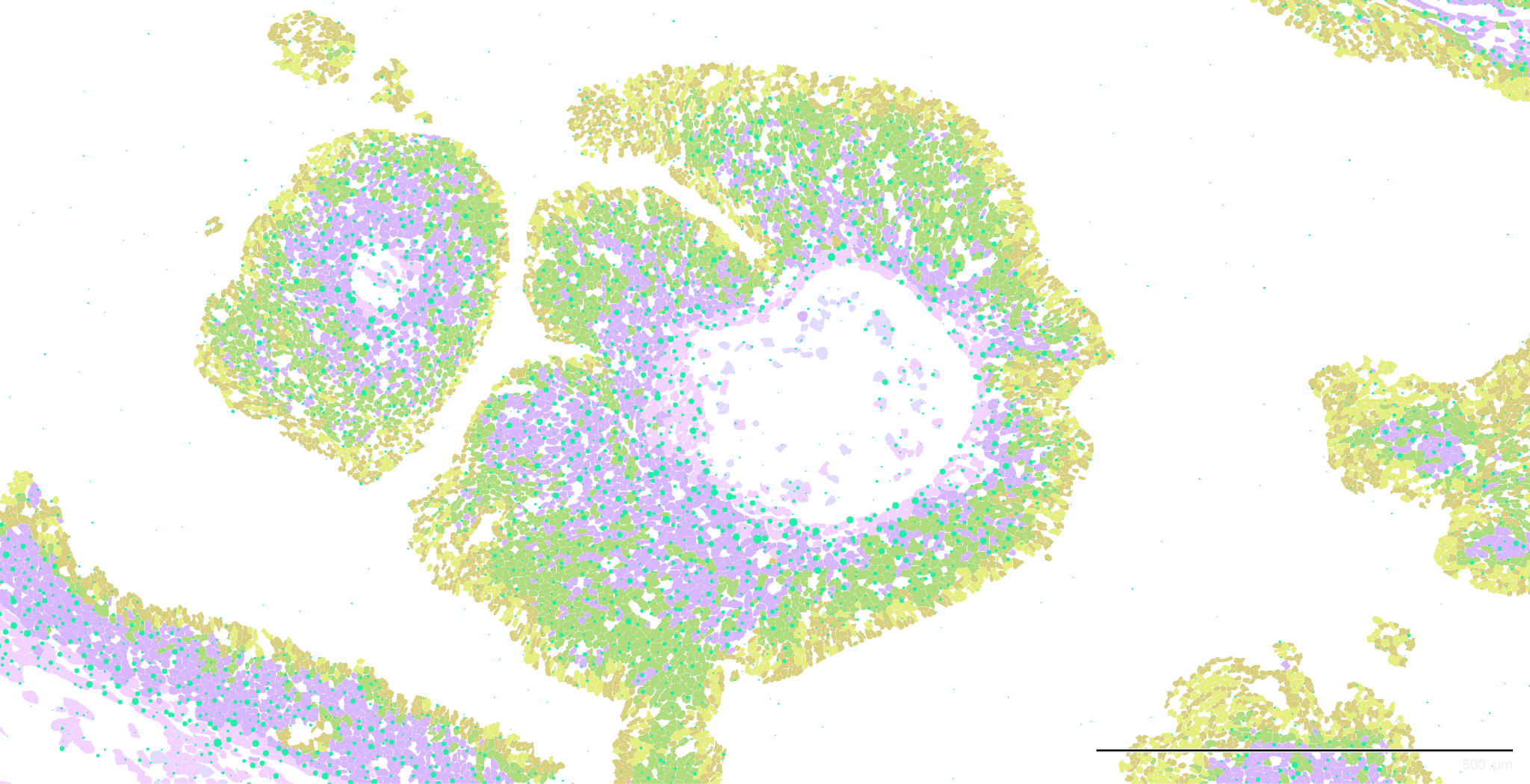
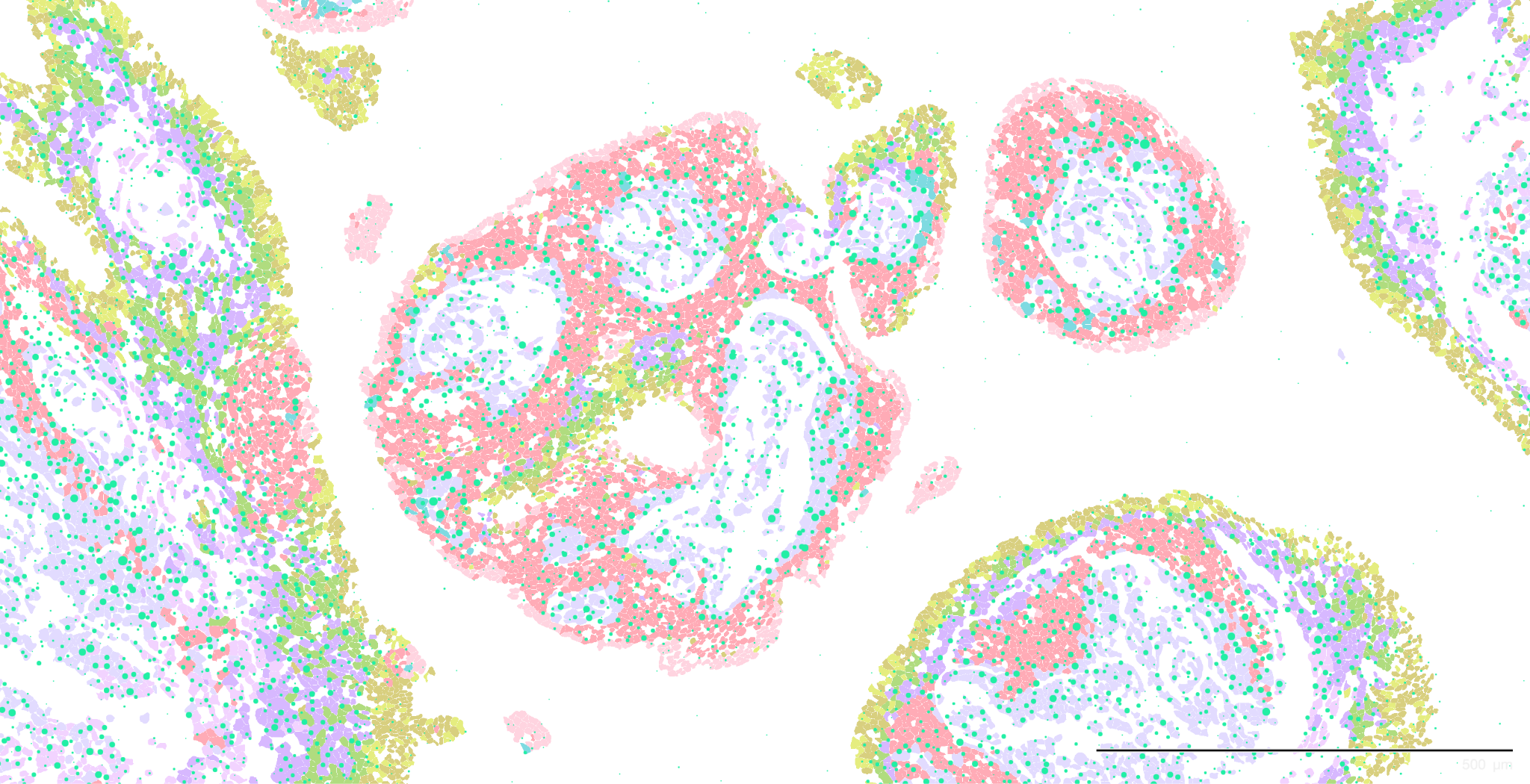
In this case, single-cell RNA sequencing gives us a hypothesis: target TROP-2. The spatial data gives us confidence that an ADC therapy could actually be used to do that.
If the technology is out there, we want it.
When it comes to tumor profiling, we know that more is more. More data, more confidence.
Developing spatial RNA sequencing will deepen our diagnostics and strengthen our insights. Most importantly, it will help us better prioritize treatment options for patients.
We’re committed to learning everything there is to know about our patients’ tumors. Our investment in spatial brings us a big step closer to that future.
