.png)
Trial selection needs to change
Trial selection needs to change
Patients and physicians need better tools to make biologically-informed decisions about clinical trials.
Perspectives

Patients with rare and aggressive cancers, or cancers with a poor prognosis under standard of care, often come to Valius to find therapeutic targets that are difficult to identify using routine diagnostics.
Recently, we had the privilege of finding two options for a leiomyosarcoma patient with a very challenging tumor.
Patient background
This leiomyosarcoma patient is in his seventies and suffering from an abdominal tumor that, given its proximity to critical organs and vasculature, is both inoperable surgically and difficult to target with radiation. Since standard of care chemotherapies for leiomyosarcoma typically have only modest efficacy and substantial side effects, the patient and their care team wanted to explore other biologically-informed therapeutic options.
Our initial findings
We began our work with this patient by performing whole exome and transcriptome sequencing to assess DNA alterations and RNA expression across all 20,000 genes in their tumor cells.
Right off the bat, we were struck by the significant amplification of the TROP-2 gene we observed in the patient’s tumor cells, which contained 54 copies of the gene (52 more than in normal cells), and the more modest amplification of the MET gene (7 copies).
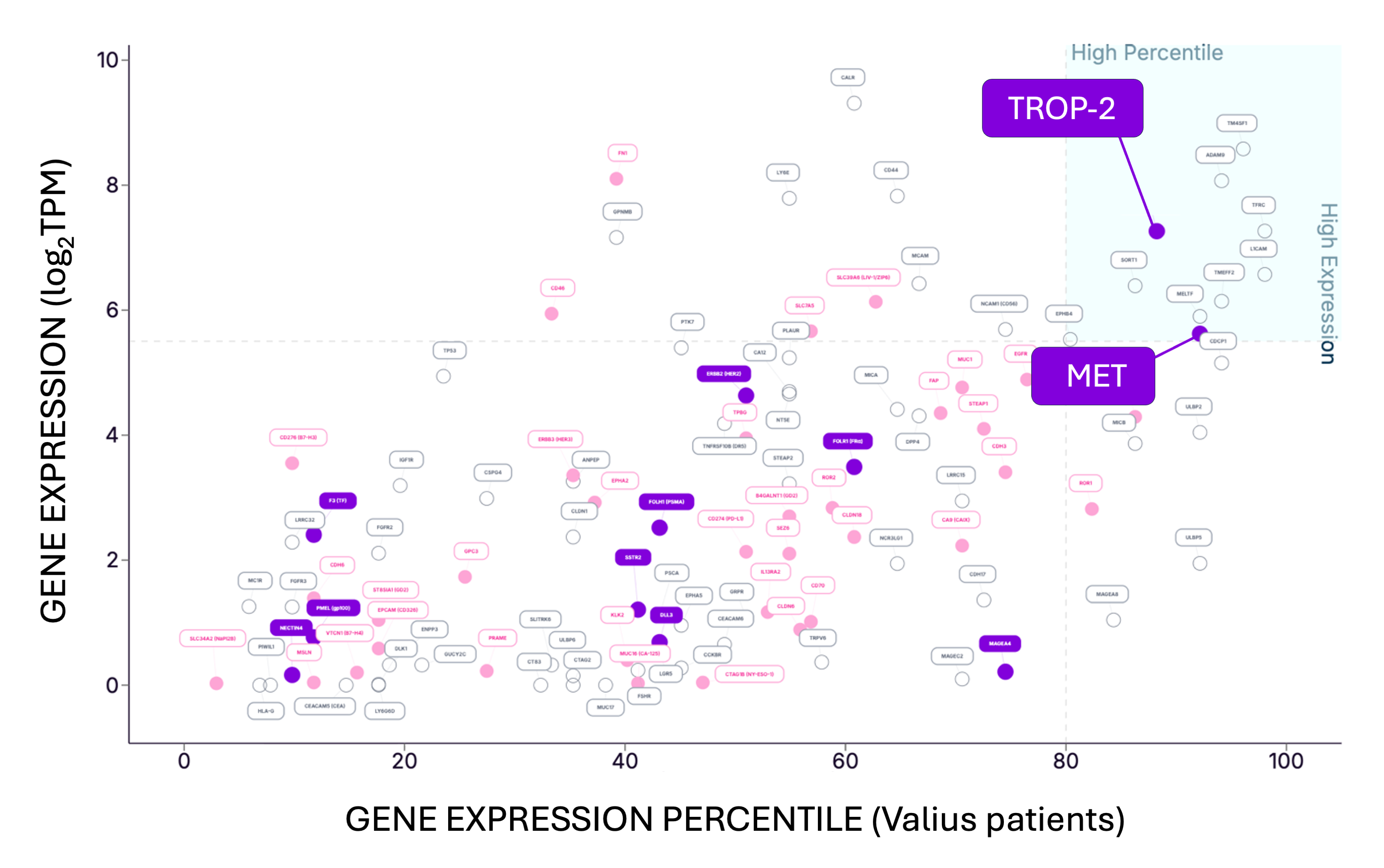
In parallel, we detected high RNA expression of both TROP-2 and MET. We tend to look at RNA expression in two ways: absolute expression (given in transcripts per million) and expression relative to other Valius patients (given in percentiles). When we plot genes with respect to these two axes, we pay greatest attention to those falling in the top right corner (i.e., those with high marks on both). Sure enough, TROP-2 and MET both ended up in that corner.
TROP-2 and MET are not commonly thought of as therapeutic targets for sarcomas. However, since both TROP-2 and MET have approved therapies in other cancer types, including breast and lung cancer, we thought it was worth digging a bit deeper to understand whether they could be clinically relevant targets for this patient.
Confirming our hypotheses
To determine if this patient might be a candidate for off-label use of approved TROP-2- and MET-targeting therapeutics, we assessed how the patient’s TROP-2 and MET expression compared to the cancer cohorts in which these therapeutics are approved. In both cases, the patient’s relative expression was reasonably high, with higher TROP-2 expression than 28 percent of breast cancer patients and higher MET expression than 49 percent of lung cancer patients.
We also wanted to confirm that the patient’s high TROP-2 and MET expression stemmed predominantly from the patient’s tumor cells, as opposed to the surrounding tissue. We did this through single-cell RNA sequencing, which allowed us to understand which cell clusters expressed these genes most highly. Sure enough, the tumor cells exhibited vastly higher expression than the surrounding tissue.
Finally, we examined this sample at the protein level and found that 30% of the patient’s tumor cells stained positive for TROP-2 with high intensity, and 95% for MET.
How we helped the patient
A few weeks ago, we met with the patient and their care team to discuss these findings. They were grateful to learn that they had new therapeutic options to consider and excited to learn more about TROP-2-targeting agents.
"We're so impressed and grateful for what you're doing" - patient's daughter
We’re currently in conversations with pharmaceutical manufacturers and sarcoma experts to further evaluate the efficacy and safety of using these agents in sarcomas, and we’re optimistic that, if the patient and their oncologist decide to pursue one of them, they’ll be able to secure access.
At Valius, we regularly identify targets missed by a patient’s prior diagnostic work. While the likelihood of finding any individual target is low (e.g., TROP-2 in sarcomas), we believe the probability of finding at least one plausible target is high.
Postscript for interested readers: explaining the high TROP-2 expression
While we were excited to uncover the patient’s TROP-2 expression and confirm it via protein staining, our science team wanted to better understand why it was so highly expressed in the first place. (To give a sense of how abnormal this expression was, consider the fact this patient’s expression of TROP-2 was in the 99th percentile relative to other leiomyosarcoma patients in our database.) Our instincts led us to investigate the rare TROP-2 DNA amplification as a starting point, which we assumed lay behind the high RNA expression.
Looking into other amplifications on chromosome 1, where the TROP-2 gene locus is located, we learned that the nearby JUN locus also had 54 copies in the patient’s tumor cells (see image below).
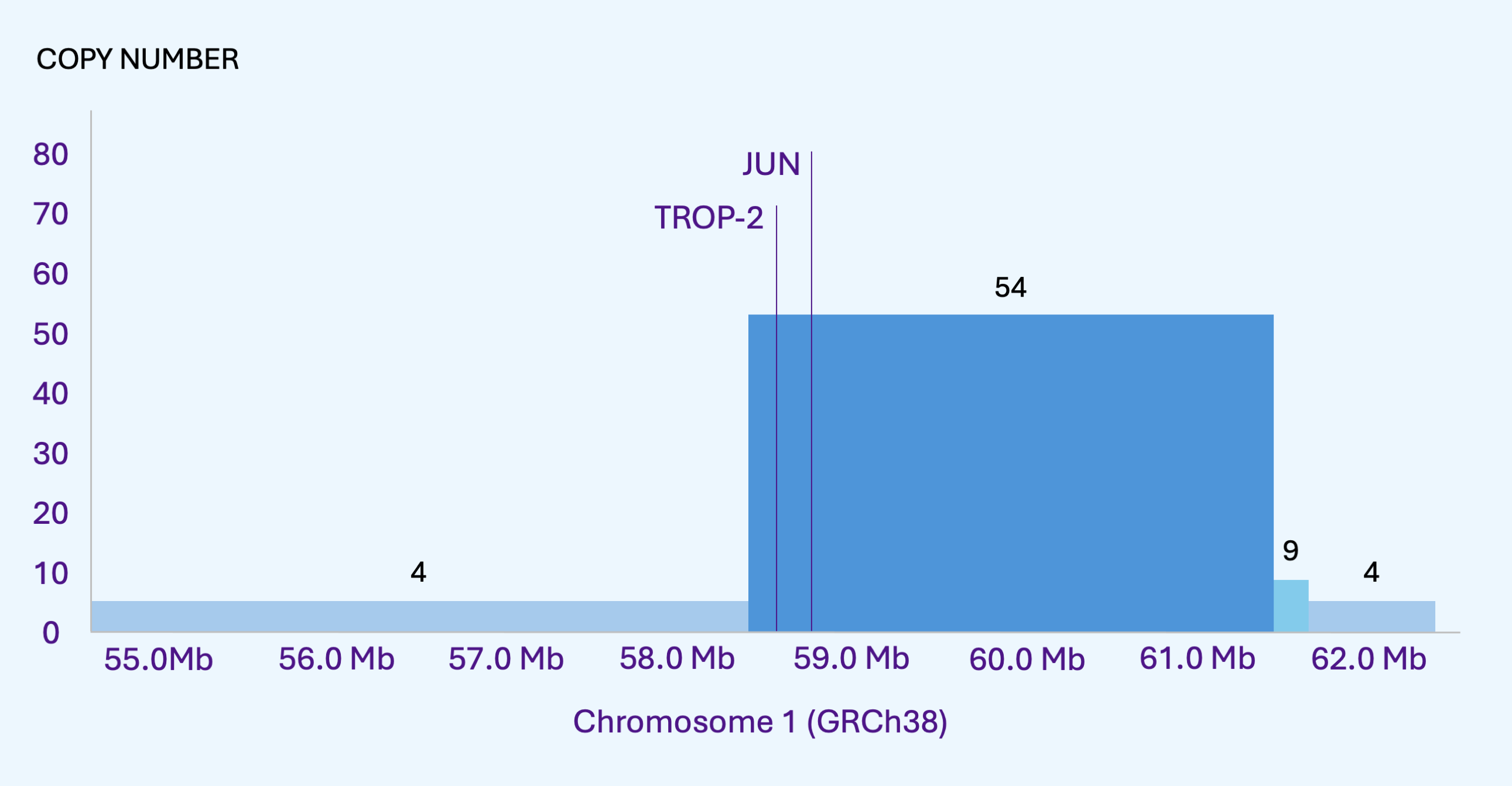
JUN is a known proto-oncogene—a gene that, when mutated or amplified, can drive cancerous growth—and JUN amplification is commonly observed in sarcomas (e.g., liposarcoma).
Consequently, our current hypothesis is that our patient’s TROP-2 was amplified in tandem with the JUN amplification. We’re continuing to study the case to learn more about the amplification of MET and other genes in the patient’s tumor.
.png)